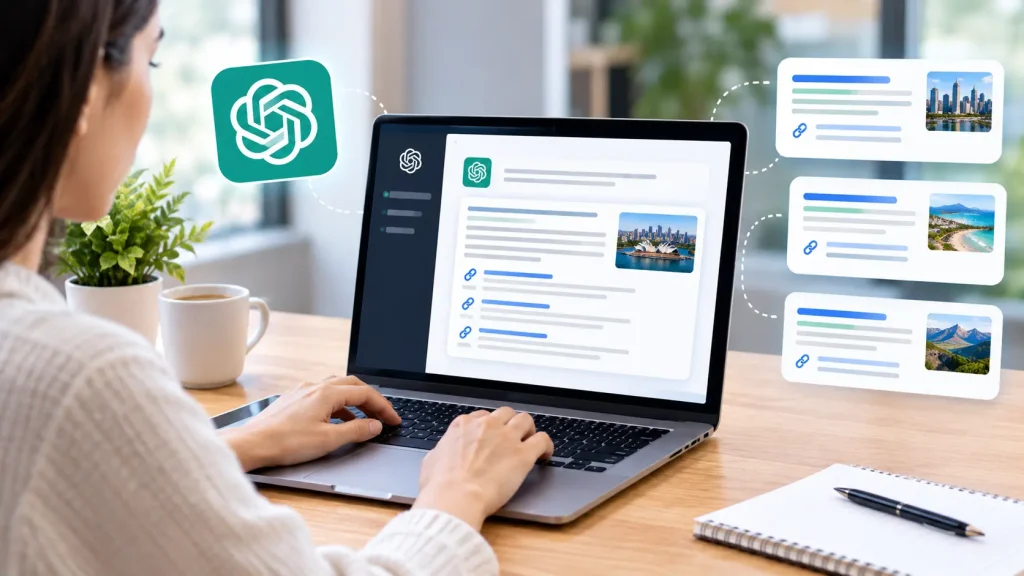
When people ask ChatGPT to recommend a service, compare products or explain a business problem, its answer may include links to websites that support the response. For Australian businesses, these links create another way to reach potential customers who may not start their search on Google. The challenge is to make your website useful, accessible and relevant to the questions your customers ask.
If you want to know how to get cited in ChatGPT, start with three things: allow the correct search crawler to access your public pages, publish useful information that answers real questions, and check how your business appears across relevant searches. These steps can improve your readiness for ChatGPT search, but no agency or technical change can guarantee a citation.
This guide covers the practical work involved, the common reasons a business may not appear, and the ways to measure progress without relying on guesswork.
What Does a ChatGPT Citation Mean for Your Business?
A citation is a link to a source that ChatGPT uses or presents to support an answer. A business mention is different. ChatGPT may name your company without linking to your website, or it may link to a page without recommending your services directly. These outcomes matter for different reasons, so it helps to track them separately.
For a business, a citation can introduce a potential customer to a service page, case study, product guide or useful blog post. It also gives the reader a way to check the information for themselves. The real value comes when this visibility reaches the right audience and leads to a relevant website visit, enquiry or sale.
| Result | What it tells you |
|---|---|
| Brand mention | ChatGPT has named your business in a response. |
| Website citation | ChatGPT has linked to a page on your website. |
| Referral visit | A person has followed a link from ChatGPT to your site. |
| Qualified enquiry | A visitor has taken a useful action, such as requesting a quote or booking a call. |
These measures should not be treated as the same result. A mention alone does not prove that your website received traffic, and a referral visit does not always lead to an enquiry. Track each stage so you can see which pages and topics support your business goals.
-
How to appear in ChatGPT search results
The first step is to check that ChatGPT search can access the pages you want people to find. OpenAI uses a crawler called OAI SearchBot to discover websites for its search features. If your website blocks this crawler, your pages will not be shown in ChatGPT search answers, although your site may still appear as a navigational link in some cases.
Ask your developer to review the site's robots.txt file, hosting rules, firewall and content delivery network settings. Confirm that OAI SearchBot can reach the public pages you want to appear in search. Also check that those pages load without a login, return a successful response and contain the main information in readable text.
OpenAI lists its crawler rules and published IP ranges in its official crawler documentation. It also notes that changes to robots.txt can take around 24 hours to take effect in its search systems. Allowing the crawler makes your pages eligible for discovery; it does not guarantee that ChatGPT will cite them.
PRO TIP
OAI SearchBot and GPTBot have different purposes. OAI SearchBot supports ChatGPT search, while GPTBot relates to collecting content that may be used to train OpenAI's models. OpenAI says site owners can set separate rules for these crawlers. Do not block the search crawler by mistake when reviewing your site's AI access rules.
-
Publish pages that answer real customer questions
Technical access is only the starting point. Your pages also need to give people useful information that fits the question they are asking. A service page that says your business offers quality solutions may tell a visitor very little about the service, its costs, its limits or the problems it can solve.
Start by listing the questions customers ask before they contact your business. For a software company, these might cover product features, integrations, pricing, security and comparisons with other products. For a professional service provider, they might cover the process, likely costs, risks, time frames and signs that expert help is needed.
Build each page around a clear purpose. Give the main answer near the start, explain the reasons behind it, and add examples or evidence that help readers assess the advice. Use headings that describe the subject of each section rather than vague headings that tell readers little about the content.
For example, an article about ChatGPT visibility should explain the relevant crawler settings, how to test citations and what to do if a company does not appear. A general article that only says businesses need good content will not give readers the practical help they came for.
-
Why ChatGPT does not mention my business
If ChatGPT does not mention your business, do not assume that the only problem is your content. Several issues may affect the result, including crawler access, the relevance of your pages, the clarity of your brand information and the sources available for a particular question. You need to test these areas before deciding what to fix.
Use the table below as a starting point for your checks.
What you notice What to check first Next action Your website never appears in tested answers OAI SearchBot access and page availability Check robots.txt, firewall rules and page responses with your developer. Competitors appear for relevant queries Their cited pages and the evidence those pages provide Compare their coverage with your own useful content and product facts. Your company name appears without a link Which sources ChatGPT uses and which pages it can access Improve the clarity and usefulness of relevant pages, then test again. ChatGPT cites one page but misses other services Internal links and the detail on each service page Add useful service information and links from related pages. Results change between tests The wording of the question and the sources shown Keep a record of the questions, dates, responses and cited URLs. These checks will not reveal every reason behind a response, since you cannot see the full process ChatGPT uses to form each answer. They can, however, help you find technical barriers and gaps in the information your website provides.
Do not copy the pages that appear in competing answers word for word. Review what they cover, identify what your customers still need to know, and publish a clearer answer with sound evidence of your own.
-
How to improve ChatGPT visibility
To improve ChatGPT visibility, focus on the information your website makes available and the evidence that supports your business claims. This includes clear service pages, useful articles, accurate business details and references from credible sources. Each part has a different role, so avoid relying on one technical change or content tactic to solve every visibility issue.
Review your main service pages first. Explain what you offer, which customers you serve, the problems you solve and the limits of your service. Include specific details that help a reader compare options, such as your process, relevant experience, case studies and answers to common questions.
Next, check your wider brand information. Keep your company name, services, contact details and location information consistent across your website and trusted business profiles. Useful mentions from relevant industry publications, professional bodies and business partners can give people more ways to verify your work. Focus on genuine references that add value, not low quality links or paid reviews.
Original evidence can also set your pages apart. Publish results from real projects when you have permission to share them, explain how you reached a conclusion, and cite reliable sources for claims outside your own experience. If you use statistics, state their source and date. Do not present estimates or small samples as proof of a broad trend.
Google's guidance for AI features in Search also points to useful, original content and sound technical SEO. Its guide to generative AI features in Google Search explains that existing SEO practices remain relevant to AI Overviews and AI Mode. Those Google guidelines are useful for your wider search strategy, but they do not guarantee citations in ChatGPT.
-
Test the questions your customers actually ask
You need a repeatable way to check your brand's presence in ChatGPT. Instead of testing only your business name, write a set of questions that reflect how customers research a problem, compare options and assess service providers.
For an Australian digital marketing agency, the list might include questions about finding an SEO agency, comparing AI SEO services, improving brand visibility in ChatGPT and diagnosing a fall in organic traffic. A software company would need a different set based on its products, market and customer concerns.
Start with around 20 to 30 questions as an initial test set. This is a practical starting point, not a number that improves rankings. Run the questions with web search enabled when available, and save the response and any cited links. Use the same wording and location context for each review so the results are easier to compare over time.
A simple spreadsheet can record the question, date, brand mention, cited page, competitors named and any relevant source links. Repeat the checks on a regular schedule and note changes. ChatGPT responses can vary, so one result should not be treated as proof that your visibility has improved or declined.
-
Measure citations, website visits and leads
A citation can be useful, but your reporting should also show if it brings the right people to your website. Use Google Analytics 4 to review referral traffic from ChatGPT when the source is recorded. Check the landing pages visitors reach, the actions they take and the number of relevant enquiries they submit.
Keep this traffic data separate from your manual citation tests. A citation check tells you what appeared in a sample of answers. Analytics reports the visits and actions that your measurement setup can record. Neither one provides a complete record of all brand mentions across AI platforms.
Track these measures over time:
Measure Why it matters Brand mention rate Shows how often your company appears in your tested questions. Citation rate Shows how often responses link to your website during the tests. Referral sessions Shows visits that analytics attributes to ChatGPT. Enquiry and conversion rate Shows if the visits lead to useful business actions. Most cited pages Helps identify the pages that appear in relevant answers. Use this information to guide your next update. If the same useful page earns citations and qualified visits, build on that subject with more in depth resources. If a page receives attention but few enquiries, review its relevance to your service and the next step it offers visitors.
Common mistakes that can hold back ChatGPT visibility
One mistake is to repeat a keyword in every heading or paragraph. This makes the content harder to read and does not add useful information. Place each phrase where it fits the question, then spend the rest of the article giving the reader a clear and accurate answer.
Another mistake is to publish many pages that answer almost the same question. This can create overlap across your own site and leave readers with little reason to visit more than one page. Give each article a distinct job and link related pages when the link helps the reader.
Do not add special markup or files on the promise that they will secure ChatGPT citations. Structured data is useful when it accurately describes visible page content and serves a clear purpose, but no special schema type guarantees that ChatGPT will use your website. Technical work should support a sound website, not replace useful content.
Finally, avoid promises that your business will appear in every ChatGPT answer. Search responses depend on the query and the sources available at the time. A responsible SEO strategy measures progress, reports the limits of the data and keeps improving the pages that matter to the business.
Frequently asked questions
How long does it take to get cited in ChatGPT?
There is no fixed time frame. Crawler access, page availability, content relevance and the query itself can all affect the result. Record a starting point and repeat your checks so you can see changes over time.
Does a high Google ranking guarantee a ChatGPT citation?
No. A strong Google presence can support your wider organic search work, but Google rankings and ChatGPT citations are different outcomes. ChatGPT may cite a different page or source for the same general subject.
Should I create a separate page for every ChatGPT question?
No. Create a new page when the question has a distinct purpose and needs a useful answer of its own. Combine closely related questions when one well planned page can answer them without becoming confusing or repetitive.
Can an SEO agency guarantee that ChatGPT will recommend my business?
No. An agency can review crawler access, improve site content, strengthen the clarity of business information and measure visibility. It cannot control every ChatGPT response or guarantee that your company will be cited.
Improve Your Search Visibility with Solution Savvy
Getting cited in ChatGPT takes more than adding AI related phrases to your website. Your pages need to be accessible, clear and useful, while your brand information should give customers sound reasons to trust what you publish. Regular testing can show where your website appears and which gaps deserve attention.
Solution Savvy helps Australian businesses improve organic search performance through SEO and practical website improvements. If your website needs a stronger search foundation, review our SEO services to learn how we can help improve your website's visibility.
For wider context on Google's AI search features and organic search, read our guide to SEO, Google AI search and local results.
Want to find gaps in your current search visibility?
Contact Solution Savvy to discuss an audit of your website, content and technical access. We can review the issues that affect your search presence and identify practical next steps for your business.